 People Development
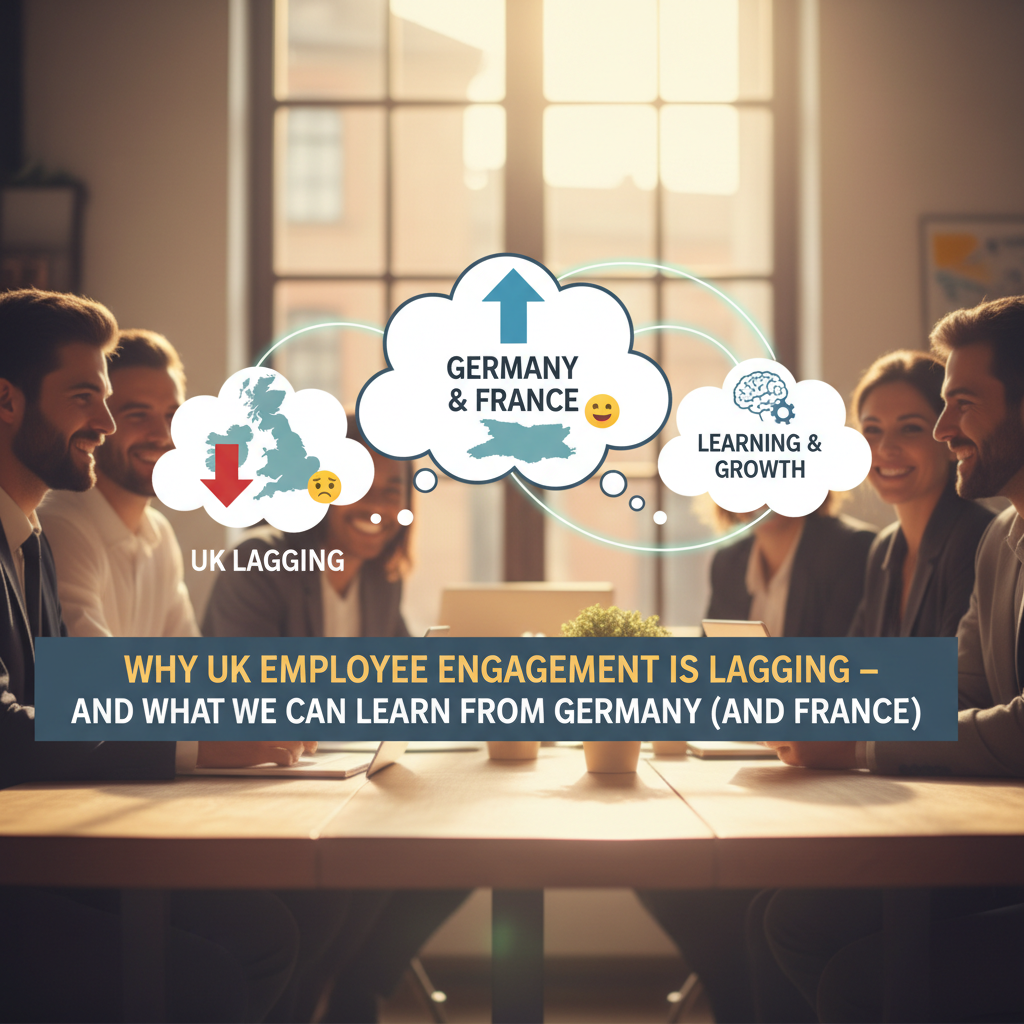
Why UK Employee Engagement Is Lagging – And What We Can Learn From Germany (and France)
Why UK Employee Engagement Is Lagging – And What We Can Learn From Germany (and France)
Employee engagement continues to be one of the clearest predictors of productivity, resilience and organisational performance. Yet the latest Gallup State of the Global Workplace 2026 report paints a sobering picture for the UK.
Put simply: Britain is part of the lowest‑engagement region in the world.
And when we compare ourselves with peers like Germany and France, the story becomes even more instructive.
The engagement gap: UK vs Germany vs France
Gallup defines engagement as more than satisfaction. Engaged employees are committed, energetic, and psychologically invested in their work. Using that definition, here’s how the three countries compare:
Germany: ~14% engaged
United Kingdom: ~10% engaged
France: ~7% engaged
European average: 12%
Europe as a whole ranks last of all global regions for engagement, well behind the global average of 20%.
So while Germany slightly outperforms the regional average, the UK sits below it, and France falls even further behind.
To put this in context:
The US and Canada report engagement levels above 30%
Latin America sits at 30%
Even regions facing far greater economic volatility show significantly higher engagement than Europe
This is not a marginal issue. The UK has around one‑third of the engaged workforce of the US.
Not angry – just disengaged
What makes Europe, and the UK in particular, unusual is how disengagement shows up.
European workers are generally:
Less angry than other regions
Less stressed than global averages
Less emotionally volatile overall
But they are also:
Less enthusiastic
Less likely to feel recognised
Less likely to feel their opinions count
Less likely to feel developed by their manager
In other words, this is not burnout-driven disengagement.
It is quiet disengagement.
Most UK employees are not actively undermining their organisations – but they are also not bringing discretionary effort, innovation or energy to work.
Gallup labels this majority group as “not engaged”. In Europe, that group accounts for nearly three quarters of the workforce.
Why Germany does slightly better than the UK
Germany is hardly an engagement success story. But it does consistently outperform both the UK and France.
The difference isn’t pay, job security or labour protection – all three countries score strongly there.
The edge comes down to manager effectiveness and work design.
German organisations, on average, score slightly higher on:
Role clarity
Manager credibility
Structured development conversations
Task ownership
These factors don’t create highly energised cultures on their own – but they do prevent engagement collapsing as far as it has elsewhere.
In contrast, the UK sits in a challenging middle ground:
Less structured than Germany
Less relationally supportive than high‑engagement cultures
Increasingly stretched middle managers
Growing span of control and role overload
The result is a workforce that complies, delivers the basics, and then stops.
France: a warning sign, not an outlier
France’s engagement level is among the lowest in Europe.
Long working hours are not the issue. Nor is intelligence, skill, or professional pride.
The drivers are well-documented:
Low trust in leadership
Weak day‑to‑day recognition
Limited perceived influence over work
“Management by process” rather than coaching
This matters for the UK because many of the same warning signs are now appearing:
Managers promoted without training
Performance conversations reduced to tick‑box exercises
Change initiatives launched without local ownership
France shows what happens when that pattern becomes entrenched.
The UK’s real engagement problem
The UK does not have a motivation problem.
It does not primarily have a reward problem.
It does not even have a workload problem.
It has a management capability gap.
Gallup data consistently shows:
Manager engagement is the strongest predictor of employee engagement
Engaged managers dramatically reduce burnout, stress and turnover
In Europe, only around 16% of managers are engaged
When managers are disengaged, employees follow – regardless of pay, flexibility or wellbeing programmes.
Why this matters now (more than ever)
Engagement is no longer a “soft” metric.
In an era of:
AI adoption
Rapid role redesign
Productivity pressure
Skills shortages
Engagement has become a measure of organisational readiness for change.
Gallup is clear: organisations with low engagement struggle to convert technology investment into productivity gains. The tools may be there – but the people do not use them well.
For the UK, this is the real risk:
Not just lower productivity today, but falling further behind tomorrow.
What high‑performing organisations do differently
Across all regions – including Europe – Gallup finds that best‑practice organisations achieve dramatically higher engagement. Some reach 70%+ manager engagement.
They don’t rely on perks. They focus on:
Manager capability as a strategic priority
Clear expectations and accountability
Frequent, high‑quality conversations
Recognition that is timely and meaningful
Real development, not just training content
The takeaway for UK leaders
Britain is not alone – but it is at a crossroads.
We can:
Drift further toward low‑energy, compliance‑based cultures
orTreat engagement as a leadership capability issue, not an HR initiative
Germany shows modest progress is possible. France shows what happens when disengagement becomes systemic.
The choice for the UK is still open.
At MiM People, we believe engagement is built in the moments that matter most:
The quality of management
The clarity of work
The experience of being led, every day
And the data is now too clear to ignore.